

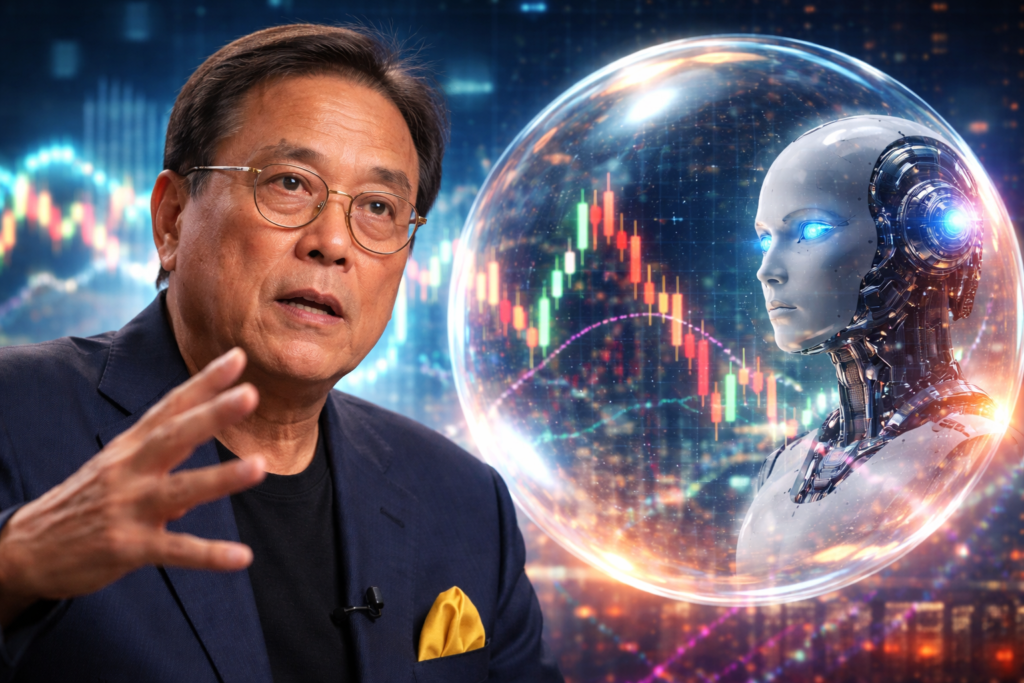
Robert Kiyosaki Warns of an AI Bubble That Could Trigger a Major Market Crash
Robert Kiyosaki, the bestselling author of Rich Dad Poor Dad, has once again sparked debate across financial markets. This time, his warning centers on an AI bubble that he believes could burst and lead to what he calls the biggest financial crash in history — possibly within the next three to four months.
Kiyosaki’s comments have gained traction as artificial intelligence continues to attract massive investment, soaring valuations, and intense media attention. But how realistic is his warning, and what should everyday investors make of it?
This article examines Kiyosaki’s claims, the current state of the AI boom, and what history and data suggest — without hype or panic.
What Robert Kiyosaki Is Saying About the AI Bubble
Kiyosaki has publicly stated that artificial intelligence is creating a speculative bubble similar to past financial manias. According to him, rapid AI adoption could:
- Disrupt millions of jobs
- Hurt consumer spending
- Trigger real estate and business loan defaults
- Expose fragile financial structures built on excessive debt
He argues that when this AI bubble bursts, the impact could spread far beyond tech stocks, affecting the broader economy.
Kiyosaki has also repeated his long-held view that traditional financial systems are fragile and overly dependent on debt and central bank intervention.
Why AI Is Being Called a Bubble by Some Investors
The idea of an AI bubble isn’t new. Several factors fuel the concern:
1️⃣ Explosive Valuations
AI-related companies and startups have seen massive valuation jumps, often based more on future potential than present earnings.
2️⃣ Speculative Capital Flows
Large amounts of money are flowing into AI themes through stocks, venture capital, and ETFs, sometimes without clear profitability.
3️⃣ Hype vs Reality Gap
AI is transformative, but real economic benefits often take years to materialize — not months.
These conditions resemble earlier technology booms, such as the dot-com era, where innovation was real but valuations ran ahead of fundamentals.
Does an AI Bubble Mean an Immediate Market Crash?
This is where caution is needed.
While AI speculation could correct sharply, a full-scale financial crash typically requires more than hype alone. Historically, major crashes involve:
- Excessive leverage
- Credit market stress
- Banking system exposure
- Liquidity shortages
At present, many analysts note that while AI enthusiasm is high, widespread financial contagion has not yet appeared in core banking or credit markets.
That doesn’t mean risk is absent — but it does mean timing a massive crash within a narrow 3–4 month window is extremely difficult.
The Employment Question: Real Risk, Longer Timeline
One of Kiyosaki’s strongest points involves job disruption.
AI will likely replace or reshape many roles, particularly in:
- Administrative work
- Customer service
- Data processing
However, history suggests labor market shifts tend to occur gradually, not overnight. Governments, companies, and workers usually adapt over time through retraining and new job creation.
A sudden spike in unemployment severe enough to crash markets would likely require an additional economic shock.
How Markets Typically React to Technology Bubbles
Past technology booms offer useful lessons:
- Innovation continues even after bubbles burst
- Not every company survives
- Markets eventually reprice risk
The dot-com crash wiped out speculative excess but also laid the foundation for today’s internet economy. A similar pattern could emerge with AI — correction rather than collapse.
A Practical, Human Perspective for Investors
Instead of panic, a balanced response makes more sense:
- Review exposure: Avoid over-concentration in hype-driven AI investments
- Diversify: Spread risk across sectors and asset classes
- Maintain liquidity: Cash provides flexibility during volatility
- Stay informed: Follow data, not social media fear cycles
Kiyosaki’s warning serves as a reminder to question valuations and manage risk — not necessarily to expect imminent disaster.
Final Thoughts
Robert Kiyosaki’s AI bubble warning highlights real concerns about speculation, job disruption, and financial fragility. However, predictions of the “biggest crash in history” within months should be viewed as cautionary opinion rather than certainty.
AI is likely to reshape the economy, but market outcomes will depend on liquidity, leverage, and broader economic conditions — not headlines alone.
For investors, the key is preparedness, not fear.
📌 Sources
- Yahoo Finance — https://finance.yahoo.com/news/robert-kiyosaki-warns-massive-unemployment-151500016.html
- The Economic Times — https://m.economictimes.com/news/international/us/biggest-market-crash-in-history-warning-why-robert-kiyosaki-urges-buying-bitcoin-btc-usd-ethereum-eth-gold-silver-now/articleshow/125663779.cms
You may also like this articles
bank of japan etf exit bitcoin liquidity
Cz says crypto supercycle 2026 regime shift
Stay Connected with Cryptolaya
Enjoyed this article? For daily crypto updates, market insights, crypto news and crypto blogs.make sure to follow us on social media. Join our growing community and never miss the latest trends!
Follow Cryptolaya on:
• facebook
Let’s grow and learn crypto together!